
ずんだボードゲーム会 @zunda_bg
ゲーム概要
| プレイ人数 | 3〜5人 | プレイ時間 | 15〜分 |
|---|---|---|---|
| 対象年齢 | 10歳〜 | 価格 | 2,000円 |
| 発売時期 | 2026秋 | 予約 | 不可 |
| ゲームデザイン | ozawa | イラスト・DTP | marufu |
ゲーム詳細
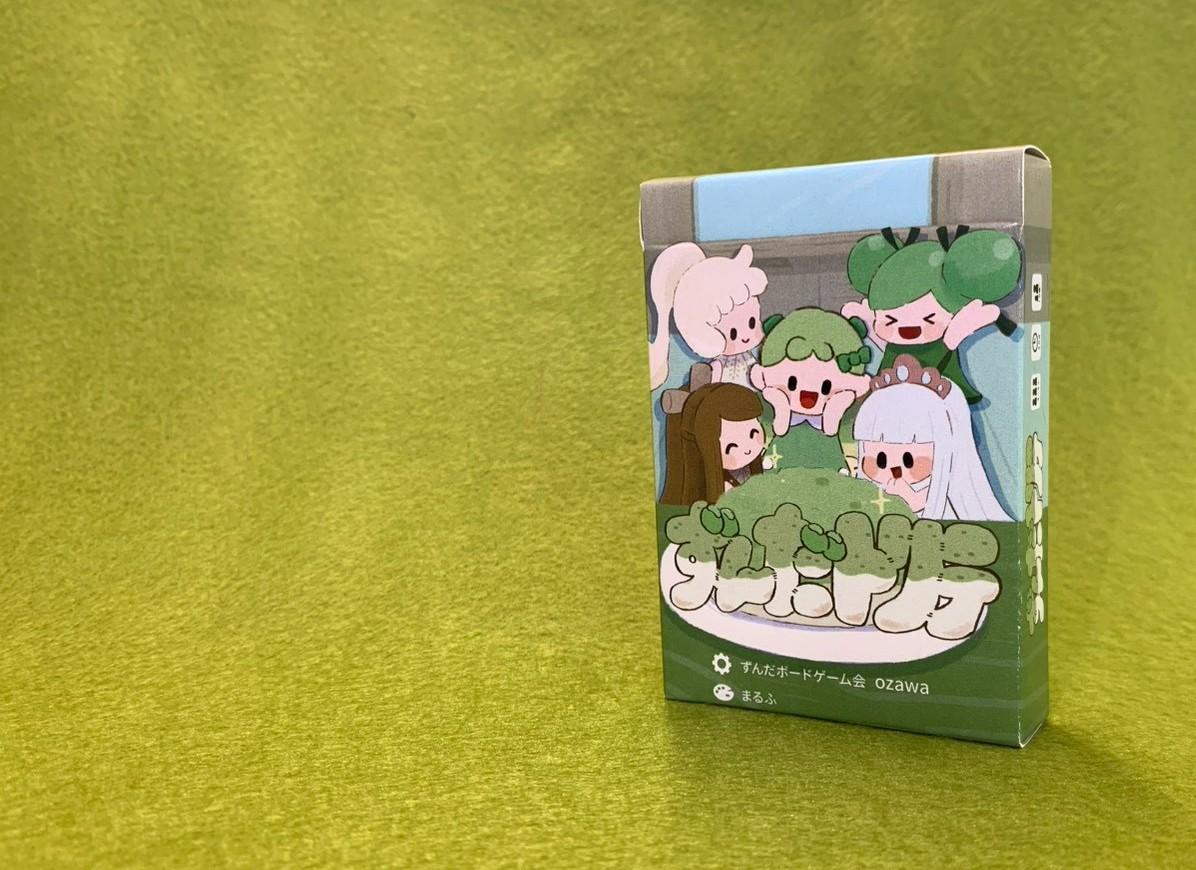
ZUNDA Trick-taking
Official Rulebook
Players: 3–5
Number of Tricks: 8
Welcome to the World of Zunda!
What Is Zunda?
Zunda is a traditional Japanese sweet paste made from mashed edamame (young green soybeans), typically mixed with sugar.
It is especially popular in Miyagi Prefecture, in the Tohoku region of northern Japan, where it has been enjoyed for generations.
One of the most famous ways to enjoy zunda is zunda mochi — soft, chewy Japanese rice cakes covered with sweet, vibrant green zunda paste.
Unlike many Western desserts, zunda has a unique combination of a mildly nutty flavor, natural sweetness, and the fresh taste of edamame.
Today, zunda is enjoyed not only with mochi but also in shakes, ice cream, and other modern desserts.
In ZUNDA Trick-taking, you'll collect the ingredients and tools needed to make delicious zunda mochi!
The Story
Four girls who love making zunda mochi have gathered for the annual Zunda Mochi Festival!
Zunda mochi makers from all over Miyagi Prefecture are eager to get their help.
Unfortunately, the four girls can't help everyone at once.
So they come up with an idea:
"Let's play a trick-taking game! The winners get to choose who helps them first!"
And that's how ZUNDA Trick-taking begins!
---
1. Objective of the Game
ZUNDA Trick-taking is a trick-taking card game for 3–5 players.
The game consists of 8 tricks.
In each trick, players compete to determine their rankings. Starting with the highest-ranked player, each player chooses one of the available Helper Cards.
After all 8 tricks, players score points based on the colors and combinations of the Helper Cards they have collected.
These points are called Zunda Mochi Points.
The player with the most Zunda Mochi Points wins!
2. Components
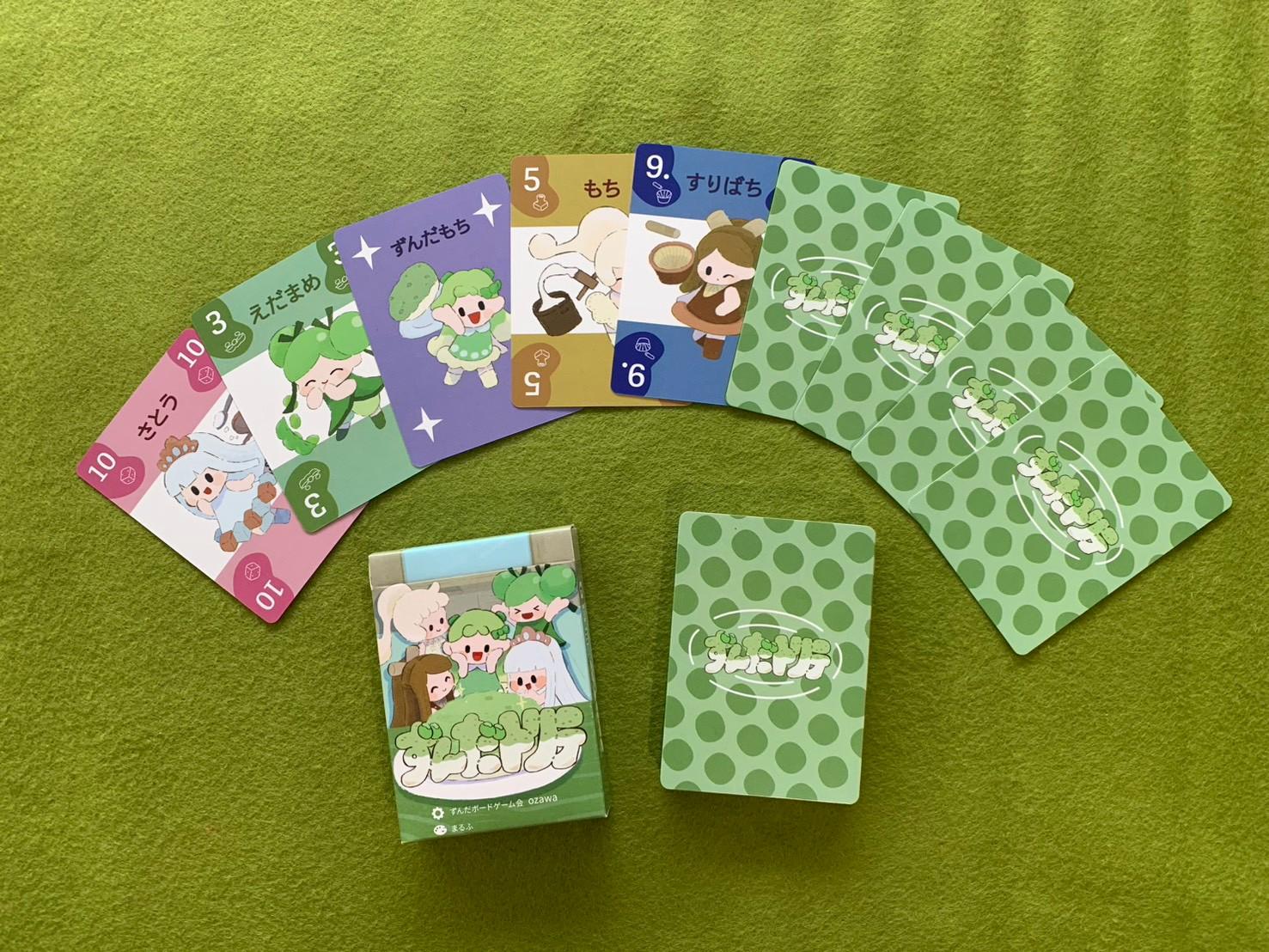
- 48 Zunda Girl Cards (4 colors, numbered 1–12 in each color)
- 1 Rulebook
There are four types of cards:
Color| Character| Represents
Green| Edamame| Green soybeans
Yellow| Mochi| Japanese rice cakes
Pink| Sugar| Sweetness
Blue| Suribachi| Japanese grinding bowl
Suribachi is a traditional Japanese grinding bowl used to mash ingredients, including edamame.
3. Game Setup
The number of cards used depends on the number of players.
Players| Cards Used| Total
3| Numbers 1–8 of each color| 32 cards
4| Numbers 1–10 of each color| 40 cards
5| Numbers 1–12 of each color| 48 cards
Setup Steps
1. Select the cards needed for your player count.
2. Shuffle them thoroughly, face down.
3. Deal 8 cards to each player. Players may look at their own cards but must keep them hidden from others.
4. Place the remaining cards face down in the center of the table.
5. Reveal a number of cards equal to the number of players plus one (players + 1), and arrange them face up in the center.
These revealed cards are the Helper Cards available during the first trick.
The remaining face-down cards are not used during the game.
Choosing the Starting Player
The player who most recently ate zunda mochi becomes the starting player.
If nobody has eaten zunda mochi before, choose a starting player using any method you like!
4. Game Overview
The game consists of 8 tricks.
Each trick follows these steps:
1. Check the available Helper Cards.
2. Starting with the lead player, each player plays one card.
3. Determine the rankings of all players.
4. Starting with the first-place player, each player chooses one Helper Card.
5. Combine the one remaining Helper Card with all the cards played during the current trick. These become the Helper Cards for the next trick.
Repeat this process until all 8 tricks have been completed.
5. Checking the Helper Cards
The cards displayed in the center of the table are the Helper Cards available to be collected during the current trick.
First Trick
There are (number of players + 1) Helper Cards.
Second Trick Onward
The available Helper Cards consist of:
- The one unclaimed Helper Card from the previous trick.
- All the cards played during the previous trick.
In other words, the cards you play in one trick become the rewards for the next trick!
6. Playing Cards
The winner of the previous trick becomes the lead player for the next trick.
For the first trick, the starting player leads.
The lead player chooses one card from their hand and plays it.
Then, proceeding clockwise, each other player plays one card.
Lead Suit
The color of the first card played face up determines the Lead Suit for that trick.
Normally, this is the color of the card played by the lead player.
For example, if the lead player plays a yellow Mochi card, the Lead Suit is yellow.
If the Lead Player Plays Face Down
If the lead player plays a card face down, the color of the card played by the next player becomes the Lead Suit.
Since only one face-down card is allowed per trick, the second player must play a card face up.
The second player may choose any color.
All remaining players must follow the Lead Suit established by the second player, if possible.
Example:
- Player A (Lead Player): Plays a card face down.
- Player B: Plays Yellow Mochi 7.
- Player C: Must play a yellow card if they have one.
- Player D: Must play a yellow card if they have one.
In this example, yellow is the Lead Suit, even though Player A played the first card.
Player A's face-down card is treated as having no color and a value of 0.
7. Must Follow Suit
Players other than the lead player must play a card matching the Lead Suit if they have one in their hand.
This rule is called Must Follow Suit.
If you do not have a card matching the Lead Suit, you may play a card of any other color.
Exception: A player may choose to play a card face down, even if they have a card matching the Lead Suit, provided that nobody else has already played a card face down during that trick.
If the lead player plays face down, the second player establishes the Lead Suit and may choose any color.
8. Special Rule: Playing a Card Face Down
On your turn, you may choose to play a card face down instead of face up.
However, only one player per trick may play a face-down card!
Once someone has played a card face down, all remaining players must play their cards face up.
How Face-Down Cards Work
A face-down card is treated as:
- Having no color
- Having a value of 0
Because face-down cards have no color, they may be played without following the normal Must Follow Suit rule.
However, since face-down cards have a value of 0, they rank below all face-up cards when determining player rankings.
Face-Down Cards Remain Hidden
Face-down cards are not revealed at the end of the trick.
They remain face down when they become Helper Cards for the next trick.
If a player chooses a face-down Helper Card, they take it first and then reveal it to everyone.
The revealed card is placed face up in front of that player, just like any other collected Helper Card.
Remember that Zunda Mochi Points depend on the colors and combinations of collected cards, not on their printed numbers.
Which Zunda Girl will come to help you? It's a surprise until you choose her!
9. Determining Player Rankings
Once everyone has played one card, determine the rankings for that trick.
Step 1: Cards Matching the Lead Suit
Players who played cards matching the Lead Suit rank higher than players who played cards of other colors.
Among cards matching the Lead Suit, the card with the highest number ranks first.
Step 2: Cards Not Matching the Lead Suit
Players who played cards of other colors rank below all players who followed the Lead Suit.
Among these cards, higher numbers rank above lower numbers.
If cards of different non-lead colors have the same number, the card played earlier ranks higher.
Face-down cards have a value of 0 and rank last.
Example 1: Green Is the Lead Suit
Four players play the following cards:
Card Played| Ranking
Edamame 10 (Green)| 1st
Edamame 4 (Green)| 2nd
Sugar 12 (Pink)| 3rd
Face-down card (Value 0)| 4th
Even though Sugar 12 has the highest number, it does not match the Lead Suit.
Therefore, it ranks below both green Edamame cards.
Example 2: The Lead Player Plays Face Down
Four players play in this order:
Player| Card Played| Ranking
A| Face-down card (Value 0)| 4th
B| Mochi 7 (Yellow)| 2nd
C| Mochi 10 (Yellow)| 1st
D| Sugar 12 (Pink)| 3rd
Player A plays face down, so Player B's yellow card establishes the Lead Suit.
Player C wins with Mochi 10 because it has the highest number among cards matching the Lead Suit.
Even though Player D played Sugar 12, it ranks below both yellow cards.
The first-place player wins the trick and becomes the lead player for the next trick.
10. Choosing Helper Cards
After determining the rankings, players choose Helper Cards from those displayed in the center of the table.
Starting with the first-place player, each player chooses one Helper Card in ranking order.
Place each collected Helper Card face up in front of you.
Do not add collected Helper Cards to your hand.
These cards will be used to calculate your Zunda Mochi Points at the end of the game.
Example: Four Players
Five Helper Cards are available.
Each of the four players chooses one card, leaving one unclaimed card.
The unclaimed card remains in the center and becomes one of the Helper Cards for the next trick.
11. Preparing Helper Cards for the Next Trick
After every player has chosen a Helper Card:
1. Leave the one unclaimed Helper Card in the center.
2. Add all the cards played during the current trick.
3. These cards become the Helper Cards for the next trick.
Face-up cards stay face up, and face-down cards stay face down.
This creates a continuous cycle:
Cards in Your Hand → Cards Played in a Trick → Helper Cards → Collected Cards → Zunda Mochi Points
12. End of the Game and Scoring
After all 8 tricks have been completed, the Zunda Girls finally finish making their zunda mochi!
Each player calculates their Zunda Mochi Points using the Helper Cards collected during the game.
Scoring Rules
Cards Collected| Points
1 Edamame (Green) + 1 Mochi (Yellow)| 6 points per pair
Sugar (Pink)| 2 points per card
3 Suribachi (Blue)| 10 points per set of 3
Only complete sets score points.
Any Edamame or Mochi cards that cannot form a complete pair score 0 points.
Similarly, Suribachi cards that do not form a complete set of three score 0 points.
Scoring Example
A player has collected the following eight cards:
Edamame (Green):
- Edamame 8
- Edamame 5
Mochi (Yellow):
- Mochi 9
- Mochi 6
These form two Edamame + Mochi pairs:
6 × 2 = 12 points
Sugar (Pink):
- Sugar 1
- Sugar 7
2 × 2 = 4 points
Suribachi (Blue):
- Suribachi 10
- Suribachi 3
These do not form a set of three:
0 points
Total Score: 12 + 4 + 0 = 16 points
Even though the player collected two Suribachi cards, they did not score any points from them because the set was incomplete.
Winning the Game
The player with the highest total score wins!
If two or more players are tied for the highest score, they share the victory.
---
13. Tips for Winning
First Place Isn't Always the Best!
Getting first place allows you to choose a Helper Card before anyone else.
However, sometimes two cards in the center are equally useful to you.
In that case, second place might be just as good!
On the other hand, there may be a particular card you desperately want, and you'll need to play a strong card to secure first place.
The key to victory is thinking about which cards you need and how to get them.
The Dilemma of Playing Strong Cards
Imagine you have a Mochi 12 in your hand.
Playing it could easily win you the current trick.
However, that Mochi 12 will become a Helper Card in the next trick, and another player might claim it!
Should you save your strong card for later?
Should you play it now to secure first place?
Or should you play it now and try to win the next trick as well, so you can claim your own Mochi 12?
The moment you play a card, you're already shaping the next trick!
Watch What Your Opponents Are Collecting
All collected Helper Cards are displayed face up in front of their owners.
This gives you valuable information about which cards your opponents may need.
For example:
"That player has collected several Edamame cards. They probably want Mochi cards next!"
"That player only needs one more Suribachi to complete a set!"
Don't just think about which cards you want.
Think about which cards you don't want your opponents to get!
---
Ready to Play?
Help the four Zunda Girls make the most delicious zunda mochi at the festival!
Play your cards wisely, collect the right combinations, and become the ultimate Zunda Mochi Champion!
Enjoy ZUNDA Trick-taking!
Variant Rule: Three-Round Game
Normally, one round is one complete game. However, if you'd like to play a longer game, you can choose to play three rounds instead.
At the end of each round, award a purple Victory Card (Zunda Mochi-chan) to the player with the highest score.
After all three rounds, the player who has collected the most purple Victory Cards wins!
If two or more players are tied for the most Victory Cards, they share the victory.